Monday, November 6, 2017

Why we are banning tourists from climbing Uluru

James Norman, The Conversation

The Uluru-Kata Tjuta National Park board of management has announced that tourists will be banned from climbing Uluru from 2019. The climb has always been discouraged by the park’s Traditional Owners (the Anangu people) but a number of tourists continued to climb the rock on a daily basis. Below, in English and Indigenous language, Sammy Wilson, chairman of the park board, explains why his people have decided to ban the climb outright.

THE Uluru-Kata Tjuta National Park Board has announced tourists will be banned from climbing Uluru, an activity long considered disrespectful by the region’s traditional owners.

Anangu have always held this place of Law. Other people have found it hard to understand what this means; they can’t see it. But for Anangu it is indisputable. So this climb issue has been widely discussed, including by many who have long since passed away. More recently people have come together to focus on it again and it was decided to take it to a broader group of Anangu. They declared it should be closed. This is a sacred place restricted by law.

It’s not just at board meetings that we discussed this but it’s been talked about over many a camp fire, out hunting, waiting for the kangaroo to cook, they’ve always talked about it.

The climb is a men’s sacred area. The men have closed it. It has cultural significance that includes certain restrictions and so this is as much as we can say. If you ask, you know they can’t tell you, except to say it has been closed for cultural reasons.

What does this mean? You know it can be hard to understand – what is cultural law? Which one are you talking about? It exists; both historically and today. Tjukurpa includes everything: the trees; grasses; landforms; hills; rocks and all.

You have to think in these terms; to understand that country has meaning that needs to be respected. If you walk around here you will learn this and understand. If you climb you won’t be able to. What are you learning? This is why Tjukurpa exists. We can’t control everything you do but if you walk around here you will start to understand us.
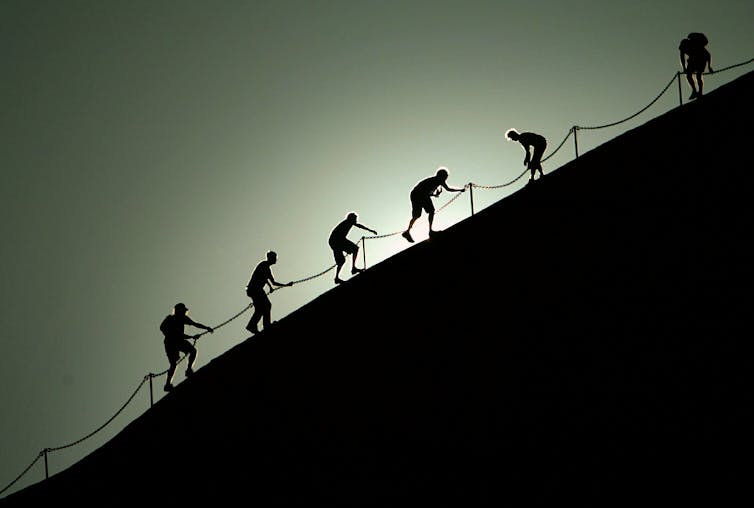
Tourists have previously used a chain to climb Uluru, but from 2019 the climb will be banned.

Some people, in tourism and government for example, might have been saying we need to keep it open but it’s not their law that lies in this land. It is an extremely important place, not a playground or theme park like Disneyland. We want you to come, hear us and learn. We’ve been thinking about this for a very long time.

We work on the principle of mutual obligation, of working together, but this requires understanding and acceptance of the climb closure because of the sacred nature of this place. If I travel to another country and there is a sacred site, an area of restricted access, I don’t enter or climb it, I respect it. It is the same here for Anangu. We welcome tourists here. We are not stopping tourism, just this activity.

On tour with us, tourists talk about it. They often ask why people are still climbing and I always reply, ‘things might change…’ They ask, ‘why don’t they close it?’ I feel for them and usually say that change is coming. Some people come wanting to climb and perhaps do so before coming on tour with us. They then wish they hadn’t and want to know why it hasn’t already been closed. But it’s about teaching people to understand and come to their own realisation about it. We’re always having these conversations with tourists.

And now that the majority of people have come to understand us, if you don’t mind, we will close it! After much discussion, we’ve decided it’s time.

Visitors needn’t be worrying there will be nothing for them with the climb closed because there is so much else besides that in the culture here. It’s not just inside the park and if we have the right support to take tourists outside it will benefit everyone. People might say there is no one living on the homelands but they hold good potential for tourists. We want support from the government to hear what we need and help us. We have a lot to offer in this country. There are so many other smaller places that still have cultural significance that we can share publicly. So instead of tourists feeling disappointed in what they can do here they can experience the homelands with Anangu and really enjoy the fact that they learnt so much more about culture.

Whitefellas see the land in economic terms where Anangu see it as Tjukurpa. If the Tjukurpa is gone so is everything. We want to hold on to our culture. If we don’t it could disappear completely in another 50 or 100 years. We have to be strong to avoid this. The government needs to respect what we are saying about our culture in the same way it expects us to abide by its laws. It doesn’t work with money. Money is transient, it comes and goes like the wind. In Anangu culture Tjukurpa is ever lasting.

Years ago, Anangu went to work on the stations. They were working for station managers who wanted to mark the boundaries of their properties at a time when Anangu were living in the bush. Anangu were the ones who built the fences as boundaries to accord with whitefella law, to protect animal stock. It was Anangu labour that created the very thing that excluded them from their own land. This was impossible to fathom for us! Why have we built these fences that lock us out? I was the one that did it! I built a fence for that person who doesn’t want anything to do with me and now I’m on the outside. This is just one example of our situation today.

You might also think of it in terms of what would happen if I started making and selling coca cola here without a license. The coca cola company would probably not allow it and I’d have to close it in order to avoid being taken to court. This is something similar for Anangu.

A long time ago they brought one of the boulders from the Devil’s Marbles to Alice Springs. From the time they brought it down Anangu kept trying to tell people it shouldn’t have been brought here. They talked about it for so long that many people had passed away in the meantime before their concerns were understood and it was returned. People had finally understood the Anangu perspective.

That’s the same as here. We’ve talked about it for so long and now we’re able to close the climb. It’s about protection through combining two systems, the government and Anangu. Anangu have a governing system but the whitefella government has been acting in a way that breaches our laws. Please don’t break our law, we need to be united and respect both.

Over the years Anangu have felt a sense of intimidation, as if someone is holding a gun to our heads to keep it open. Please don’t hold us to ransom…. This decision is for both Anangu and non-Anangu together to feel proud about; to realise, of course it’s the right thing to close the ‘playground’.

The land has law and culture. We welcome tourists here. Closing the climb is not something to feel upset about but a cause for celebration.

Let’s come together; let’s close it together.

In Pitjantjatjara language

Anangungku iriti kanyiningi ngura Tjukurpa tjara panya. Tjinguru kulipai, ‘ai,ai, ah, nyaa nyangatja? What is Tjukurpa?’ Putu nyangangi panya. Palu Tjukurpa pala palula ngarinyi Ananguku. Ka palunya kulira wangka katiningi tjutangku. Kutjupa tjuta not with us panya. Kuwari wangka katiningi, wangka katiningi munuya kaputura piruku wangkanyi ka wiya, Anangu tjutangka piruku wangkara wangkara kati. Uwa ngalya katingu Anangu tjuta kutu. Ka Anangu tjutangku wangkangu palya, patila. Ngura miil-miilpa.

Not only the board meeting kutjuya wangkapai, meeting time kutju but meeting out in the campfire, waru kutjara. Waru kutjaraya malu paulpai tjana wangkapaitu still.

Uwa Tjukurpa wati tjutaku uwa… wati tjutangku patini, that’s it, Tjukurpa palatja patini. Only Tjukurpa kutju, uwa Tjukurpa tjarala patini, miil-miilpa. If you ask some people, kutjupa tjapini ka, you know they can’t tell you, palu tjinguru patini, Tjukurpa.

Nyaa palatja, nyaa panya? You know sometimes it’s hard to understand panya: Tjukurpa nyaa? Which one? Ngarinyi tjukurpa, iriti tjinguru ngarinyi, Tjukurpa and he’s still there today. You know Tjukurpa is everything, its punu, grass or the land or hill, rock or what.

Palula tjanala kulintjaku, uwa kulinma nyuntu: ‘Uwa ngura Tjukurpa tjara’. Respect ngura, the country. You walk around, you’ll learn, understand. Tatini nyuntu munu putu kulini, nyaa nyuntu? What you learning? Pala palutawara; Tjukurpa. Ka we can’t tell you what you’re doing but when you walk around you understand. Kulini.

Some might be… you know, tourism, government-ngka, ‘no, leave it open, leave it’ Why? palumpa tjukurpa wiya nyangakutu. This is a very important place nyangatja panya. Not inka-inka, not to come and see the Disney land. Wiya come and learn about this place. Rawangkula kulilkatira kulilkatira everywhere.

Ngapartji ngapartjila tjunu, to work together, but they gotta kulinma panya. Munta-uwa, tjana patini nyangatja, ngura miil-miilpa. Uwa. If I go some sort of country tjinguru ngura miil-miilpa, some place in the world they got miil-miilpa, I don’t climb panya, I respect that place. Pala purunypa nyangatja Ananguku panya. Ka tourist nganana stop-amilantja wiya; tourist welcome palu these things, nyangatja nyanga, panya.

Uwa, tour-ngkala ankupai. Visitors-ngku kulu kulu wangkapai, you know sometimes we was working with tourism panya, tourist-angka and, ‘why these people climbing? Kana, ‘Something is coming’. I always talk panya. Ka, ‘why don’t they close it?’ Ka uwa its coming always, ngaltu tourist tjuta, visitors. Some people, ‘I want to climb’ sometimes visitors climb Uluru munu ngalya pitjala on tour, why I climb? Alatji, why don’t they close it. Ka wiya, it’s coming now you know, nintintjaku, visitors kulintjaku munta-uwa. Uwa minga tjutangka wangkapai, always.

Uwa kuwari nyanga kulini, kulini, everybody kulinu, munta-uwa wanyu kala patila. Wangkara wangkarala kulini, munta-uwa.

Visitors-ngku panya kulilpai, ‘ai nyangatjaya patinu ka nganana yaaltji yaaltji kuwari? Nganana wai putu kulilpai’. Wiya, Tjukurpa ngarinyitu ngura, outside. Not only this park unngu kutju palu tjukurpa nganananya help-amilalatu ngapartji ngapartji ka nganana ngapartji katinyi visitors tjuta. Some reckon nobody living in the homelands but this good story to tell to the visitors panya. Ka nganananya help-amilantjaku kulu kulu. Government gotta really sit down and help. We got good places up here.

Ngura kulunypa tjuta nyarakutu ngarinyi but he got Tjukurpa tjara. Not Tjukurpa panya nyanga side but only this side, the public story. Uwa. Uwa. Ka tourist tjinguru kulilpai, ‘ah, I done nothing in this place’ but katira nintini, sit down and talk on the homeland, uwa. Nyinara wangkara visitors kulira kulira, they’ll go happy, ‘munta-uwa I learnt a lot about Anangu’.

Money is the land whitefella see, ka Anangu see the ngura, the land is Tjukurpa. Tjukurpa wiyangka tjinguru wiya. Culture kanyintjikitjala mukuringanyi. Culture tjinguru mala, another fifty years tjinguru panya, another hundred years, culture is gone, ma-wiyaringanyi. Nyara palula we gotta be strong. Ngapartji ngapartji panya government will understand, munta-uwa, what they saying. It doesn’t work with money. Money will go away, it’s like blowing in the wind, panya. Walpangku puriny waninyi. Culture panya Ananguku culture - Tjukurpa is there ngarinyi alatjitu.

Iriti Anangu bin go and work on the stations. They work for the station manager he want his land, block of land and uwa munta-uwa nyangatja nyangatja. Anangu was camping there, putingka. Building their fence because its boundary. Boundary palyanu that’s the law, whitefella-ku law to look after cattle or sheep or whatever oh that’s the law, Anangu was building it, Anangu working and Anangu now is sitting outside, he can’t get in! malaku, ngura nyakuntjikitja. Putulta kulini, ‘ai? Why? nyaakula fence-ingka patinu? That was me! I built a fence for that bloke and that bloke don’t like me, I’m outside now. Munta nyanga purunypa, same, what I’m saying.

Tjinguru nyaa kulintjaku you know… I built a coca cola factory here. That coca cola factory might say no! Hello, close it otherwise he’ll take me to court. Pala purunypa is Ananguku panya.

Iriti they bring this rock without knowing. They bring the rock from Devil’s Marbles to Alice Springs. Palunya ngalya katingu ka Anangu tjutangku putu wangkara wangkara that tjinguru paluru iriti righta ‘wai! Why that thing from here is over here?’ Wangkara wangkara wangkara wangkara wangkara wangkara, some pass away-aringu palu purunypa people understand, ‘hey we gotta take this back!’ Tjukurpa paluru tjana kulinu.

That’s the same as here, wangkara, wangkara hello, palya patinila. You know, ngura look out-amilani tjungu, still the same panya, government and Anangu. Anangu is the government too but this government, whitefella government, panparangu nguwanpa. Wiya, panparangkuntja wiya please, we gotta be tjungu. Respect.

Iritinguru Anangu nguluringanyi nguwanpa, nguluringanyi, ah! someone is watching us like with a gun: ‘Don’t close it please’… don’t point me with a gun. Pukularintjaku Anangu and piranpa, together, tjungu, uwa munta-uwa, patinu palya nyanganyi the playground.

Ngura got Tjukurpa. - vistors nyangatja welcome ngura. Tjituru tjituru wiya nyangatja - happy palyantjaku.

The ConversationWiya, come together, wiya come together patintjaku.

James Norman, Section Editor, The Conversation

This article was originally published on The Conversation. Read the original article.

Monday, May 2, 2016

Open letter to the Minister

This letter was printed and posted to the Health Minister, Hon Sussan Ley MP this morning.


Tuesday, April 19, 2016

Allegorical tale posted elsewhere this morning.
Antonio, the mayor of your town has decided to set up a free pizza home delivery service.
Everyone who pays rates pays an additional 1.75% per annum to cover the cost of the service.
Everyone is happy ... except of course those who don't eat pizza, but there are very few of those so the local newspaper does not really pick it up as a story. The headlines are all in support of a great social service for a community need. After time even those who don't eat pizza decide to regularly order free home pizza because they feel that because they pay their rates they should have the benefit.
Antonio's brother is employed to run the service. All above board, the council approves the appointment.
The demand increases, so much so, that a number of people in town are employed to deliver the free home pizzas. They don't get paid well for this though, because pizzas actually don't cost much and because of budgetary constraints Antonio has frozen the CPI increase in the amount paid to the pizza business to provide the community service.
Antonio's brother, the smart business man that he is, hatches a plan to increase the profit of the business.
He decides to add extra anchovies to the basic pizza being delivered for free to anyone who wants a pizza. He even has an advertising campaign to promote the improved value ... "cheaper than a restaurant meal" goes the headlines.
What Antonio does not know is that his brother is now billing the council for deluxe pizzas at four times the cost of the basic pizza.
What the people do not know is that they are getting the basic pizza with anchovies but their request for basic (with extras) pizza is being paid for as though they are receiving the deluxe pizza.
What Antonio is beginning to understand is that the 1.75% is not enough to cover the uncapped number of pizzas being requested by the community but knows it will be political suicide to increase rates further.
What Antonio also knows is that if he stops the free pizza delivery service it will be the end of his career as a Mayor.
Antonio's mother also reminds him that if he stops the service the homeless, disadvantaged and poor of the community will no longer have access to food.
Sadly Antonio has not yet discovered that the council is being ripped off by his brother. No one has performed an audit, although there are some suspicions voiced by a few.
Antonio is looking at the system they have back in the home country that involves importing basic, pre-made, bulk produced frozen pizzas. The plan is also to limit the number of pizzas people can have in a year. The cost can be contained by reducing the quality, standardising the production, streamlining the delivery and capping the amount available. Most people will be happy enough because at least they still get pizza for free, even if it isn't as good as it used to be. Antonio will be very happy because he keeps his job as mayor. He just has to find a way to legally get rid of his brother.
This is not a story about pizzas.
Antonio is a fictional character.
No anchovies were harmed in the production of this story.


Friday, June 14, 2013

The Conversation - Renal disease in indigenous Australians

Kidney disease in Aboriginal Australians perpetuates poverty


By Roger Smith, University of Newcastle and Kirsty Pringle, University of Newcastle


The recent death of the lead singer of Yothu Yindi, is a high-profile example of an event all too common in Aboriginal Australia.


Older Aboriginal Australians (40 to 60 years old) are more than 15 times more likely to die of kidney disease than non-Aboriginal Australians. This is an age that’s normally the prime life. But not only is it a tragedy for the individuals involved but has a much wider effect on the community.


Elders in all communities are a repository of knowledge and of accumulated wealth. Early death of key older family members deprives younger community members of the benefit of accrued knowledge of culture and both financial and social support.


The structure of the broader Australian population is like a pillar with similar numbers of people in all age groups. This means that a young non-Aboriginal child will often receive support and guidance from two mature adults with back up from four, still-living grandparents.


The population structure in Aboriginal Australia is quite different and is more like a triangle, with many more children than adults and even fewer living grandparents. This means that an Aboriginal child receives support and guidance from far fewer adults.


This pyramid like structure is generated partly by early death of Aboriginal adults from heart disease, diabetes and kidney disease.


Not a great start


Heart disease, diabetes and kidney disease are non-communicable diseases that are strongly influenced by the environment. Increasing evidence suggests that all three begin as the baby is developing in the uterus. This concept is known as fetal programming or the developmental origins of adult health.


Let us explain by using kidney disease as an example to illustrate the concept. Skin sores can become infected with the bacteria known as streptococcus, this type of infection can lead to kidney damage known as glomerulonephritis. This can happen in childhood, and, if it happens to a girl, her kidneys may already be damaged by the time she becomes pregnant.


The insidious cycle of kidney disease in the Aboriginal population. Jonathan Paul


Studies in pregnant sheep have demonstrated that if the mother’s kidney function is damaged, then the kidneys of the developing fetus also become damaged. This allows kidney damage to be passed across generations.


Studies by others suggest that this is happening to many Aboriginal mothers and their babies. Aboriginal mothers often have evidence of kidney disease already present during pregnancy and Aboriginal babies are frequently born with a much smaller number of nephrons (the functional units of the kidney). Typically around 400,000 while non-Aboriginal babies have over one million.


This reduction in nephron numbers is linked to impaired growth within the uterus of many Aboriginal babies who are born too small (known as growth restriction), twice as often as non-Aboriginal babies.


A better way forward


If we are to close the gap in Aboriginal life expectancy and well-being, we need to focus on the beginning of life inside the uterus. We need to ensure high quality care and support for Aboriginal mothers and their babies.


We need to develop ways of identifying babies at risk of kidney disease early to prevent deterioration of kidney function that could be transmitted across generations into the future.


Progress is being made. In Tamworth, a research team from the University of Newcastle’s department of rural health is recruiting young Aboriginal mums and their children and seeking to identify markers of kidney impairment in urine samples.


In Townsville, a neonatologist is using retinal photographs of newborn babies’ eyes to identify those at risk of kidney disease (the blood vessels at the back of the eye reflect the way the blood vessels in the kidney are also developing).


If we can reduce the burden of kidney disease, we can improve not only the health of Aboriginal Australians but also their cultural and material wealth by allowing more older Aboriginal people to transmit their knowledge and resources to the next generation. Intervening early in life to optimise health is a much more effective strategy than trying to correct accumulated damage in later life.


Acknowledgement: Della Yarnold also contributed to this article.

Roger Smith receives funding from the National Health and Medical Research Council.


Kirsty Pringle does not work for, consult to, own shares in or receive funding from any company or organisation that would benefit from this article, and has no relevant affiliations.
The ConversationThis article was originally published at The Conversation.

Read the original article.

Friday, February 22, 2013

Mini-guide to Locum doctor aspirants.

I have, over the last couple of weeks been giving a little advice to others about Locum work and some of the problems experienced. Learning, generally, is the gaining of knowledge from someone of experience willing to share that experience, whether it be "scientific truths", anecdote, or the admission of mistake in the hope the learner will not be required to make the same mistakes.

Check list :

1) register yourself for an ABN and register for GST. You can register as a sole trader, you do not need an additional company entity, however you must seek financial advice on your options and what best suits your personal situation.

https://abr.gov.au/abrweb/default.aspx?pid=71
2) register for Medicare HPOS and obtain a PKI security dongle. This will allow you to apply for a provider number online and receive it within minutes, as long as you have no provider number restrictions. This is a personal identifier, do not let anyone else use it or access HPOS with your log on.

http://www.medicareaustralia.gov.au/provider/business/online/register/apply.jsp

Update June 2016 :  PRODA is now the best way to access HPOS

https://proda.humanservices.gov.au/pia/pages/public/registration/account/createAccount.jsf


3) choose a Locum agency, one with a good reputation and preferably one that comes highly recommended by a colleague you trust. Talk to someone at the agency, don't apply yet, just talk, get information and get a sense whether or not you are happy to work with the agency. Remember you are a valuable commodity to the agency, their survival depends on the commissions generated by the work you do via their referrals. Get on their email list and then sit back and observe two things. The frequency of communications and the quality of placements being offered. Don't be in a rush, sit back and wait ... you will have other things to be doing while you wait. Get yourself on the email list of two other agencies and do the same, wait and observe. Do not be in a rush to commit.

4) While you are waiting, create a Resume/CV ... it needs to be the perfect generic CV that clearly summarizes your training and experience from the moment you entered medical school. It must be clear, succinct and easy to read. First impressions count. Get some professional advice on how to write your CV, the money paid for this will be returned tenfold and more.

http://careers.bmj.com/careers/advice/view-article.html?id=3043

5) Get two references from contemporary professional peers, written by your referees and with those referees willing to be spoken to by both the agency and prospective "employers". Your referees need to be able to confirm intimate knowledge of your professional skills in the area of work you are seeking. Whenever your reference is 12 months old, get new ones, and if possible renew them every 6 months.

6) Gather 100 points of identification documents.

http://www.transport.nsw.gov.au/content/100-point-check-proving-your-identity
7) Gather your original qualification documents - ie. your graduation certificate and your FRACGP or equivalent.

8) find a JP near where you are. Don't stuff around with other people for document certification, some places will only accept a JP certified copy.

http://australia.gov.au/topics/law-and-justice/justices-of-the-peace
... or "google" find a JP and choose the finder site for your state.

9) Make six copies of your 100 points of ID documents and six copies of your qualification documents. Call a JP nearby and ask for an appointment to have documents certified. JPs don't get paid to do this job so be polite and accept the possible inconvenience of the timing of that appointment. Don't take shortcuts and get a non-JP to certify the documents.

10) Get a Federal Police check done .. Yes, at your expense. This will consume your first set of ID documents.

http://www.afp.gov.au/what-we-do/police-checks/national-police-checks.aspx
11) Book yourself in for an advanced life support course.

12) By now you will have received a number of emails from your chosen agencies. Remember you have not committed yet, just receiving email lists of Locums available. Is there a state you would prefer to travel to? Pick one .. best to start with just one. Do you choose based on where you would like to travel? Do you choose based on the type of work available? Do you choose based on the amount paid?

13) Now you have chosen which state you want to do your first Locum, get a state Working With Children Clearance. Go on, "google" it. Yes, this too is at your expense. Each state has their own and will be valid only in that state. The following link is only as an example - it is for the Northern Territory and will only be valid for NT.

http://www.workingwithchildren.nt.gov.au/

14) no, you are not ready yet ... if you has reached frustration point already, leave now ... you are not suited to Locum work.

15) find yourself a simple invoice generator (eg software for PC, app for mobile device) ... ask around to find out what is out there and make sure you know how to use it.

16) Now is the time to choose your Locum agency. Choose one and stick with them. Make it clear to them you are committing to just them and you expect a high level of service for that commitment, but don't hesitate to move on if you are not happy. The agent will send you the registration package that will have at least a dozen pages of application paperwork, including declarations and providing proof of immunization status. This is likely to be needed if you are working with or in association with any hospital service, even small regional hospitals that the GP clinic provides medical services to.

17) By this time you will realise you will need access to a fax machine and or scanner. Get one for your home if you don't already have access to one elsewhere. Also find a means of storing copies of all your documents in the "cloud" so you can access them whilst traveling.

18) Once your Locum agent has indicated that all the paperwork is complete including consuming a full set of your certified documents, you are almost ready to choose your first Locum placement.

19) Almost, because you need financial savings to cover at least the period of time you are doing the Locum and then some more. Choose a short Locum for your first one, in your travel comfort zone. Expect to travel initially without your family ... not all places provide suitable family accommodation, and very rarely do they cover family member expenses of any sort. If your first placement is for two weeks, double that for a savings."cushion" to live off. Make sure you have enough to live on for at least the period you are away. Do not expect prompt payment. Many will pay promptly but don't allow yourself to be dependent on prompt payment for your family's financial survival in case a delay in payment does happen.

20) Now wait for that Locum placement that ticks all your boxes in terms of where and when. When it comes, express an interest with your agent but ask details of where, who for and if another Locum has been there and given feedback. Then if it suits, double check the arrangements for travel, accommodation, vehicle if provided, and timing of payment of invoices. Then, if still happy, ask the agent to put forward your details for consideration and patiently wait.

Give very serious consideration to getting legal advice on all the contracts you sign, before you sign and make sure your level of medico legal insurance will cover the type of work expected of you.

Enjoy your foray into Locum work. It provides variety, experience and opportunity to travel like no other. And remember to be joyful for the opportunity you have been given. And please, give consideration to prioritizing your work in rural areas ... rural doctors always need assistants. You never know, you may find a place of heaven you may wish to move to longer term.

Thursday, February 21, 2013

2012

Twelve months go by and it is time to review the year that was. 2012 began with 2011 Christmas and New Year in Julia Creek and then almost three weeks in Normanton, both under the auspices of the Mt Isa health district of Queensland Health.It was also the year I started a little photographic project, taking a photo every day for the year of 2012 and unimaginatively called it "Project 366".

 You can find the link to the final product here ... on my Facebook page.

 It was a full year. I entered into a challenging financial arrangement by purchasing a high end property in a fast falling market (ie. bought at about about 70% of the building cost) which has now stabilised but has a high mortgage to service for the next 5 years before settling to a basic interest/principle repayment system. I deliberately loaded repayments at the front end to minimise risk if the valuation goes pear shaped. As a result any non-full-time working life has been pushed to about 15 years into the future, which suits a "standard" retirement age rather than "early" retirement and gives me a more focussed approach to work planning.

 So yes, 2012 was a full year. Julia Creek, Normanton/Karumba, Gin Gin, Gladstone (Indigenous health), Clifton, Cooktown (incl Wudjal and Hopevale), Orbost, Gladstone (hospital ED), Innisfail (2.5 months), Brisbane Northgate, Yulara (2.5 months) and for the first time in a few years, spent Christmas at home.

The year was professionally and emotionally challenging.   Firstly my Queensland Health state-wide credentialling was up for renewal and there was talk about an "unfavourable reference" that, of course, all refused to give me details of what and who for "privacy reasons" and for a period of about ten days I discovered what sleepless nights was all about.

At the same time a locum that was pre-booked and already contracted to the Mt Isa hospital ED was cancelled without explanation other than talk about my credentialling being renewed and the "unfavourable reference".

As it eventuated, my credentialling was renewed and shortly afterwards I was given a Queensland Health job for two weeks in Cooktown.

As the year progressed it became more obvious that I had been "banned" from working in the Mt Isa district, without explanation, without formal notification and without recourse.  In a petty sort of way, I got enjoyment from the fact that the $1300 airfare that Mt Isa paid in advance for my locum that was cancelled was actually not recovered by the Mt Isa district but lost because no one cared to follow up the cancelled locum's expenses.  We hear about financial mismanagement within Queensland Health, this was just a small example of financial carelessness.

The medical director of Mt Isa hospital rang and welcomed me to the district during my Julia Creek placement but did not show any sort of professional courtesy in letting me know why he refused to allow me back into the district after my Normanton placement.

To the best of my knowledge there has been no formal complaint to the Medical Board about my professional competence, there has been no formal complaint to the Health Services commissioner, there has been no formal complaint to the Queensland Health Director General.  Simply a "you cannot work in the Mt Isa district".

I have pondered for almost the whole year how to address this issue.   I have come to the conclusion it was a reaction to my harsh and quite verbal criticism of the standard of care being provided to the community of Normanton and Karumba.  A standard of care that was in my less than humble opinion, substandard, unsupervised and  delivered by someone who showed disrespect for other people around them.  The staff of the clinic and local hospital feared to speak up, and the community (85% indigenous) did not like him and dreaded his return each time a locum who covered his leave left.

I drafted on more than one occasion a letter of concern to be addressed to the area Medical Director (Mt Isa), to the Queensland Health Director General and to the Australian "medical board" AHPRA.

I ended up leaving it as a detailed and harsh appraisal through the locum agency.

I feel sad for the community of Normanton, but the standard of health care in the world is not my personal responsibility - I simply provide the best I can where-ever I am at the time.

During the year of 2012 I had the good fortune to meet someone who knew the circumstances in Normanton personally and her experience was not too dissimilar to mine and from that time I felt a little more comfortable that my assessment of the standard of service provided in Normanton was pretty close to the mark, not purely personal bias.

About mid-year, I went back to Gladstone Hospital ED to revisit a place I had become fond of years earlier.  It was an experience that left a bitter taste in my mouth.

Most of the good nursing staff had left (and continued to leave later in the year), all the good doctors had left, as had the personal assistant to the Medical Superintendent and the hospital was still managed by a "locum" Medical Superintendent who I found hard to be convinced was actually serving the hospital's best interests.   The welcome to me from the Med. Super. was to pass on a petty, unfinished business from two years earlier where I was accused (inappropriately) of leaving my accommodation in a mess and he instructed me that this must not happen this placement.  He in fact interrupted my attempt at explanation and with that I knew this whole experience was not going to go well.

A "primary care clinic" was set up as a trial alternative for lower acuity emergency department patients in preparation to create a Medicare scam to have patients who otherwise should have had their care funded by the hospital (state funded) to be funded at least in part by Medicare billing (federal funds).   The state vs federal war has been going on for decades, but I was not happy being placed in an, in my view, immoral setup that was incompetently managed with dysfunctional workflow.  I made my views clear, including to a unit manager who had the audacity to complain to me that the wait time was too long when 8 patients who all turned up to ED at about 8:30am were all triaged to my "primary clinic" queue (single doctor) whilst the ED was empty of patients and two doctors were sitting on their arse doing nothing.

I was also, under duress, required to complete a purely theoretical training package to "accredit" me to perform procedural sedation.  I pointed out that a theoretical training package without any practical component was in fact potentially dangerous ... and not surprising, something that again they did not want to hear.   I answered the "test essays" truthfully and listed the minimalist approach I would take based on my lack of anaesthetic training and skills and received absolutely no feedback despite assurances by the "medical trainer" that I would.

My second week was, without prior notification, a week of night shift, solo senior doctor not only in the emergency department, but for the whole hospital.  Could I keep my mouth shut ?  No, of course, and it came to a crisis point that despite the hospital knowing well in advance I was flying out on the Friday morning they had rostered me on the overnight Thursday night shift.  I refused to work the shift.

The reference I received, not surprisingly suggested that I was "unsuitable for emergency department work".  Yes, I am old and grumpy enough to not tolerate substandard and under-resourced health care systems.  Once again, not a formal complaint to the Medical Board or the Health Services Commissioner about my competence as a doctor, just simply a closure of another door because I was outspoken enough about perceived competency and service level deficiencies at such a level to be potentially dangerous for patient care.

In the context of consistently positive references for the previous four years, and the rest of my 2012 references of a similar high standard, I was confident that it was my lack of "keeping my mouth shut" that resulted in a process where the assailed became turtles and sought to deny me further access to the ability to observe system and possible personal failings.

Yes I am arrogant ... my role as patient advocate drives me to speak out against injustice.

So, with needing two emergency department references to work in emergency departments and without two references I could not work in emergency departments to actually obtain the necessary two references, it was clearly time to move on.

2012 and the early part of 2013 has reinforced my desire to continue to work supporting communities in rural and remote Australia that lack good quality health care services and confirmed that doing locum work is still a privileged way to see Australia, especially when I am paid to do it and when Lesley, my wife, has the opportunity to travel with me any time she chooses.

I make a final note of my 2012 experiences that I am greatly honoured to have spent 10 weeks in the country around Uluru and Kata Tjuta, central Australia.  I acknowledge with heart felt thanks the traditional owners of the land and the elders of the Anangu people.


PS ... as a gentle reminder to younger doctors who's career is dependent on whose arse you lick and turn a blind eye to, seek legal advice if you are ever to "open your mouth" against injustices and medical incompetence.  You have a difficult choice to make.

Thursday, September 20, 2012

More from The Conversation

Man v mountain: how to overcome the evidence overload

By Joseph Ting, University of Queensland

Most doctors shudder at the sight of the growing mountain of unread medical journals gathering dust on their desks over months, if not years. They need not despair though, as there are less time-consuming ways to keep up-to-date than meticulously working your way through the journal pile.

Of course, one could simply walk away from the threat posed by the information overload avalanche, cancel journal subscriptions, not buy the latest medical textbooks or ship the lot to a needy medical library. But the out-of-sight out-of-mind approach risks the doctor being left behind.

Doctors are expected to be attuned to the latest developments in health care, keeping pace with extremely well-informed patients. The rhetoric of medical research underpinning optimal health care is incompatible with the grinding reality of busy work life.

So our lassitude with keeping up to date with the latest research is, we believe, excused by busy clinical practice and the accelerating pace of modern life. And the flood of new evidence gives clinicians only a remote chance of breaking the surface and catching breath, let alone reaching the summit of the journal mountain.

www. shutterstock.com

What’s more, doctors may not be able to confidently recognise and understand important and reliable developments, let alone decide on their relevance to patient care. Most remain unenamoured of the bruising and seemingly irrelevant encounters with statistics and research methods from their undergraduate years.

And after a long work day, a demanding journal article can’t compete with relaxation and family time. Serious engagement with an article is, for most of us, not conducive to rest and recreation.

Two decades after leaving medical school, my enthusiasm about the latest issue of the New England Journal of Medicine often extinguishes the fire of work tearoom conversations. Like-minded colleagues (those unshackled from the entrenched cultural disdain for research) are a rare species found only at journal clubs, teaching hospitals, medical schools and conferences.

Time constraints and apathy aside, there’s the other not inconsequential problem of discerning crop from chaff in the research. How to keep up with the latest research relevant to one’s clinical practice and verify what’s claimed by new drugs, tests and technology?

But keeping abreast of the latest research is important because doctors can’t deliver the latest evidence-based health care if they’re not aware of it. Patients benefit from doctors keeping up to date and being knowledgeable about recent studies that are reliable as well as being relevant to clinical practice.

Treatments evolve rapidly and established drugs and procedures may turn out no better than placebo. Doctors also need to be vigilant about newly discovered side-effects or harm resulting from reputable treatments.

Henry Rabinowitz

Careful scrutiny of drug-company sponsored clinical trials could lead doctors to the conclusion that exciting but expensive new treatments are not superior to reliable old work horses. Sponsored studies may ignore comparisons with long-established effective drugs (there’s little income in established patent-expired drugs).

If only doctors had the time at work (preferably paid and without clinical obligation) and the necessary skills to assess the methodological robustness of a study, decipher its findings and apply its conclusions to patients. Such favourable conditions are rarely available outside the journal club, postgraduate training, teaching hospital and medical school.

If health executives really care about research bearing relevance to patient care in ambulatory and community practice, they need to fund doctors to train in appraising the quality of what they read and pay them for the time spent keeping up to date. Better informed doctors are likely to deliver better care and dividends in improved care will likely outgrow remuneration to doctors.

Ultimately, there’s nothing better than scrupulous journal reading or attending conferences to stay in touch with the latest research evidence. But alternative strategies for the time-poor include:

  • Participation in specialist college on-line continuing medical education activities or moderated clinical topic websites;

s_falkow/Flickr

  • Attending non-sponsored local hospital medical education sessions is difficult as they are scheduled within office hours so webcasts can offer flexibility;

  • Registering for e-list-servers of research relevant to their work (including abstracts and selected editorials) and e-alerts of the contents for major general medical and sub-speciality journals;

  • Reliably moderated medical guidelines and texts (many available online) such as Up-to-Date, e-Therapeutic Guidelines. These circumvent the need to assess the primary studies individually; and

  • Adhering to the latest treatment guidelines from learned entities such as the Acute Coronary Syndrome recommendations of the National Heart Foundation and acute asthma strategies from the National Asthma Foundation.

Burgeoning health-care evidence needs to be efficiently delivered to doctors caring for patients in digestible allotments that will not prove overwhelming. This involves communicating information relevant to their clinical practice or specialty, in a format and schedule compatible with achieving balance in a doctor’s work and personal life.

Paying doctors for non-clinical time to learn about the latest evidence is a good start. Even if one has not assessed the original studies, investigation and treatment summaries updated with newly emerging clinical research provides a short-hand way for ensuring patients receive the best of care.

Joseph Ting received funding from ARC Linkage Grant for Emregency Health Services Qld Study 2007-2011.

The Conversation

This article was originally published at The Conversation. Read the original article.

Friday, March 9, 2012

Reproduced from "The Conversation"

What Australia should do about prescription opioid misuse

D4h4y33y-1328670070
Knowing the dose of the tablet means overdoses are less common than with heroin. d ab d z/Flickr
Consumption of slow-release prescription opioids has been increasing in Australia for about two decades. Now, the federal government has said it will set up a new $5 million national electronic records system to improve monitoring of these drugs.
The Electronic Recording and Reporting of Controlled Drugs system will be made available to doctors, pharmacists and state and territory health authorities across Australia to monitor the prescribing and dispensing of addictive drugs in real time.
Before the government moved toward national implementation, this system was tried out in Tasmania and evaluated favourably.

Consumption trends

Consumption of these drugs began earlier and increased faster in the United States. Overdose deaths from prescription opioids there first outnumbered such deaths from heroin and cocaine in 2000. That gap has steadily widened in the past ten years. And more and more people in the United States struggling with dependence on prescription opioids have been coming forward to seek help.
So we know the pattern of what would happen in Australia if we allowed consumption of prescription opioids to keep increasing. Canada and the United Kingdom have also reported similar developments to Australia.

Road to problems

Doctors prescribe opioids to treat pain from cancer, acute pain (such as after an operation or heart attack) and chronic pain not due to cancer. They’re usually very effective for the first two sorts of conditions but nowhere near as effective for the latter.
In Australia, prescriptions for opioids are obtained by a relatively small number of people who visit a large number of doctors to obtain huge quantities of these drugs. Profits from selling the drugs on the black market are very high because people who enjoy taking opioids for recreational purposes have found heroin a little harder to purchase since a heroin shortage started in Australia in 2000.
Another contributing factor to the increasing use is the growing difficulty in recent years of getting on to methadone and buprenorphine programs. There are no votes in funding these forms of treatment, even though 70% of the community now support them.
So, many heroin users have started buying prescription opioids from the black market, crushing these tablets and injecting them. Overdoses are less common than with heroin because, unlike street heroin, the dose of the drug in tablets is known.

Effective interventions

Australian health authorities have known all this for a while. But it’s a complex problem that crosses commonwealth, state and territory governments. And within each department of health, several sections have to be involved.
There’s no silver bullet but a number of strategies will help, especially if some leadership is applied to the problem. Unfortunately, leadership is a scarce commodity in Australia’s current volatile political climate, with attempts at major health-care reform taking up a lot of time.
And we are now moving to a national real-time, web-based data system for prescriptions. That will help, but efforts to stem the supply of drugs in the face of strong demand, while politically irresistible, often promise more than they end up delivering.

Important steps

Improving the treatment of chronic non-cancer pain will have to be part of the solution.
Most of this treatment is provided by general practitioners. While Australia has a surfeit of excellent guidelines for treating chronic non-cancer pain, none are written by general practitioners for general practitioners.
We also need a whole system for training allied health professionals to help manage chronic non-cancer pain with non-pharmacological treatments. But there’s no training course, no qualification and no way of funding this at present. So general practitioners will continue to prescribe large quantities of prescription opioids while treating chronic non-cancer pain.

Other options

Expanding methadone and buprenorphine treatment and making these more affordable to drug users, who generally have low-incomes, would also make the black market for prescription opioids less lucrative.
We need to develop a new treatment system for people struggling with dependence from prescription opioids. While there’s some overlap with the population using heroin, some of the people who develop problems with prescription drugs are quite different from heroin users.
A national policy for prescription opioids and benzodiazepines is now being prepared and this is a positive step since Australia has never had a policy covering these drugs. It seems ironic that these legal drugs have been ignored for so long. Many of the people who enjoy taking prescription opioids and heroin recreationally also take benzodiazepines.

Path least travel

In the alcohol and drug field, the politics of implementing effective responses are generally much more complex than working out the right public health interventions. And the cost of politically attractive policies that don’t work is getting harder to bear in an era when government budgets are stretched to breaking point.
The lesson of Australia’s heroin epidemic of the 1990s was that politicians must start getting serious when increasing numbers of deaths begin occurring among middle-class kids.
This effort by the Federal government to create a national electronic record system for prescription opioids is a step in the right direction. But unless it is supported by a range of other measures, there is a risk that it will send us backwards. Supply measures are easy to sell to the public but are often disappointing and sometimes seriously counter productive.

This article was originally published at The Conversation. Read the original article.

Thursday, February 23, 2012

Lying to patients

This is a transcript of a video presentation on Medscape. Medscape is a site that requires registration and logging in, so I reproduce the transcript here to permit wider observation and discussion.

 Lying to Patients: No Huge Ethical Failure, Says Bioethicist Arthur L. Caplan, PhD

 I am Art Caplan, and I am at the University of Pennsylvania in the Department of Medical Ethics and Health Policy. Today I would like to talk to you about a pretty thorny subject and one that is fascinating because it is so ethically rich: Should doctors ever lie to their patients?
The trigger for this discussion is a study that just came out that found that doctors do lie. In fact, the study found that 20% of more than 2000 doctors surveyed admitted that they had not told patients the truth when an error had taken place. They found out that more than 10% hadn't discussed financial conflicts of interest, and 15% said they gave a rosier picture about prognosis and risk and benefit with respect to a disease.
There has been a good deal of interest in this survey, and the public and some media reports are saying that this is shocking. We expect our physicians to always be truthful; this survey apparently shows that there is a considerable amount of lying going on, withholding of the truth, and not being forthright. What's wrong? Is there a huge ethical failure going on out there among doctors and medical practitioners?
The answer is no. It is inexcusable and not advisable to lie about an error. You may dodge a bullet on that one by having the patient not find out, but if it really affects their care, if they wind up harmed, if they wind up having to pay more and it comes out later that you didn't tell the truth or that there was an omission of the fact that an error occurred, you are going to get clobbered. I have seen it again and again in courtrooms. It may seem the easiest way out, to avoid telling the truth when an error takes place, but getting it out there and getting it over with early is the best protection in terms of malpractice associated with error. It isn't lying.
With respect to financial conflict of interest, patients have a right to know about it, and it should be brought up. But a lot of patients don't care, so you can get around that very quickly. You don't have to lie or withhold information. You can simply offer the patient the opportunity to know that you see a lot of drug representatives or that you went out to dinner and learned about this drug, and they probably will say, "Doctor, I don't care. What do you think is the right thing for me to do?" Making the offer is a better way to deal with something that a lot of patients don't think is all that important.
What about that circumstance in which a better prognosis is offered than is really the case for the patient? That circumstance, and a couple of other topics, are real ethical gray zones. It is not as clear that lying is always bad. Think about the use of a placebo. If you think that you can save a patient money and save them a lot of risk and side effects by giving them a placebo to see if it will calm their anxiety or help restore their sexual function, I am not sure that it is always wrong to prescribe a placebo. It is controversial, but I am not sure one is always wrong in trying to deal with a difficult or noncompliant patient, or one who has a bad, unhealthy lifestyle.
Is it wrong to "up the ante" a little bit and scare the patient more than you might otherwise about the consequences that might follow from their bad behavior? I am not sure that that is wrong either. The goal is good, and by being a little bit on the far end of the truth about what could happen to them, I am not sure that it isn't worth it. With respect to the "rosy prognosis," if someone has cancer or Parkinson disease or Alzheimer disease, I'm not sure that they want to hear in the first visit exactly what is going to happen to them or the grim nature of the statistics.
You might say that telling the truth is a noble thing to do, an important thing to do, and it is the way that we are going to keep patients trusting the doctor. At the same time, however, truth is not an event; it is a process. The survey may have failed to capture that insight. Telling the truth is important, but letting it come across in a humane way, letting it come across sometimes in "dribs and drabs" so that the patient can absorb it and not be psychologically devastated or emotionally harmed, is the right thing to do.
So, don't lie about mistakes, don't lie about conflict of interest, and be forthright when things go wrong. When there is a reason not to be trusted, let the patient decide how they want to manage that. Truth is a better policy. In some other areas, the truth, although it ought to come out eventually, is probably something that is more of a tool to be worked with in trying to help patients than it is an absolute necessity all of the time.
I am Art Caplan at the University of Pennsylvania. Thanks for watching.

Friday, February 17, 2012

Visit the outback's mechanical victims

Visit the outback's mechanical victims - ABC Southern Queensland - Australian Broadcasting Corporation

Just a little light diversion from medical, but a look at the outback that many of us "out here" are familiar with.

Friday, February 10, 2012

Three weeks break and back to it

After a three week break and a settlement on a new property in Port Douglas (we are now officially mortgage stressed according to the stats) I return to work with three weeks of 24/7 at Julia Creek and nearly four weeks (also 24/7) at Normanton. Both places are in far north Queensland but are vastly different.

 Well ... I guess a comment on the property purchase first. Having worked in FNQ for over 5 years and especially loving the area around Cairns, and having watched the real-estate market for over three years around the Mossman Port Douglas area, I decided to make a significant life decision. Instead the option of working locums part time and relatively casually, I have effectively committed myself to working close to full time for at least another 5 years. I guess it was to create an additional purpose to the reason why one works for an income by buying a second "home away from home". Melbourne is still our home, and for quite important family reasons will remain so for at least the medium term future (if one can plan for such anyway) but a house/villa in Port Douglas gives my family a second locale to enjoy the fruits of my labours.

 Julia Creek ... in central north Queensland on the main road between Mt Isa and Townsville. A relative small town, with a 16 bed hospital built in 1972, in the middle of cattle country. A wide, open and expansive place. Two pubs in town, two small "supermarket" type stores, railway along the edge of town. Friendly people. Had Christmas and New Year in Julia Creek. I have a few photos of the area in my Project 366 album. The work was relatively quiet, apparently those who would have left town for the holiday break had already left, and others were preparing for a long, isolated stay on station when the wet hits.

 Normanton ... further to the north and much closer to the Gulf of Carpentaria, about 75km circuitous drive to the coast. I am there currently. It has a high proportion of indigenous people in town, three pubs, a couple of small "supermarket" style stores. It is on the edge of "wet country". The bird life is abundant, including the more exotic brolgas that are a delight to see both on the ground and in the air. 

The work is quite different to what I was doing in Julia Creek, including more after hours work, more hospital admissions and a twice a week trip to Karumba on the coast to run a clinic. It is now wet season and despite (at this instant in time) it not raining every day, when it does rain it is quite heavy, and add to that the water from "upstream" and the wet country being tidal, many roads into and around Normanton are now closed.

 Had an interesting experience yesterday when the road to Karumba was officially open but the 07:30 report said there was 450mm (others in the know were saying 350mm+) of water (flowing) over the bridge on the road to Karumba. 4WD only and "use extreme caution" ... well no way I was going to attempt the trip in a yuppy 4WD (a lot of these around but the high clearance work vehicles usually not supplied by Queensland Health) so my "extreme caution" measure was to not go. Council refused to authorise a helicopter shuttle (about 9 minutes flying time I am told) because the road was still officially open, so the clinic had to be cancelled.

 Interesting "tropical medicine" in the area ... learned about a few bugs I had never heard of and some I had forgotten about.

  Stenotrophomonas maltophilia causing a wound infection is not nice. I am also reminded that alcohol consumption is the bane of some remote communities and a significant reason for after hours presentation for medical treatment.

 Yarrabah from the end of February is not a happening thing, other arrangements are in place to cover the medical services from Cairns doctors on rotation. I expect this will eventually be good for the community at Yarrabah to have the "indigenous medicine naive" medicos become aware of the different needs of our indigenous brothers and sisters and hopefully temper the racism in the medical care in the larger centres.  Interestingly a recent study confirms that racism (unconscious or otherwise) is present in our medical system in Australia.

 I am currently having my locum agents (hi Sarah and Charlie !!) working on getting me a placement in Gladstone (its been a long time since I have been there) and possibly followed by work in Mt Isa (twelve months since being there). Nothing definite booked after that except just over 2 months in Uluru October - December this year.

Will chat again another time.

Monday, February 6, 2012

Cross promotion

Another rural locum blog .. a little more generic and probably designed to be more politically correct with the intention to promote life as a rural doctor, not that I need convincing but many city doctors haven't a clue what they are missing out on.

http://ruralchampions.govspace.gov.au/author/rhwa/

Friday, February 3, 2012

It has been remiss of me ...

.. and I once again find my blog languishing, but given the close knit nature of the communities I have worked in over the last 6 months it is difficult to share my experiences without risking breach of patient privacy. Not that it can't be done, it will just require more thought that just random placing of thoughts on virtual paper.

I promise, an entry with particular references to my experiences up here in Julia Creek and Normanton/Karumba will be forthcoming.

Sunday, January 1, 2012

Project 366

One photo each day in 2012


Taken with iPad, photo editing software Photogene.

Link to album online here. (( link changed to public Facebook link ))

Friday, November 4, 2011

Thank you Dr Vlad

"We need to say stop to those whose
personal, corporate or governmental
greed threatens to undo what we
already have."

The full article can be found here on the last page,Australian Rural Doctor, October 2011.

Monday, October 31, 2011

Yarrabah now has no pharmacy service

It appears, according to my reading of the Yarrabah Primary Health Care Centre Indigenous Land Use agreement it "includes" pharmacy services ... I don't know whether this is political speak that it (at the time of the agreement) provided pharmacy services or if there is any obligation to provide pharmacy services.

Whatever the actual obligation, the pharmacy service that was here is now closed.

This means unhappy and angry community members.

This means sub-standard health care, both medical and dental.

Yarrabah has not been approved for Section 100 of the National Health Act so we are reliant on the goodwill of a nearby pharmacy to provide a non-profitable dispensing service to the community.

The eligibility criteria for participation in the program are given below.


Eligibility criteria

. The Health Service must have a primary function of meeting the health care needs of Aboriginal and Torres Strait Islander peoples.
. The clinic, or other health care facility, operated by the AHS from which pharmaceuticals are supplied to patients must be in a remote zone as defined in the Rural, Remote and Metropolitan Areas Classification 1991 Census Edition.
. The AHS must not be a party to an arrangement, such as a coordinated care trial, for which funds from the Pharmaceutical Benefits Scheme have already been provided.
. The AHS must employ or be in a contractual relationship with health professionals who are suitably qualified under relevant State/Territory legislation to supply all medications covered by the Section 100 arrangements and undertake that all supply of benefit items will be under the direction of such qualified persons.
. The clinic or other health care facility operated by the AHS from which pharmaceuticals are supplied must have storage facilities that will:
- prevent access by unauthorised persons;
- maintain the quality (eg chemical and biological stability and sterility) of the pharmaceutical; and
- comply with any special conditions specified by the manufacturer of the pharmaceutical.

Yarrabah is RRMA 5 (a new classification system is in place, but the Department of Health Section 100 page still refers to RRMA classifications)

The Department of Health and Aging refers to Yarrabah as being "outer regional" incidentally exactly the same as Cairns, the major town about an hour's drive away.

Unless Yarrabah is reclassified it will never gain access to the Section 100 system.

Here's hoping there will be another pharmacy prepared to assist the community and quickly.

Meantime, our "after hours" stock of medications are dwindling fast.

Wednesday, October 19, 2011

The financial imperative for honest doctors

Honesty in the medical profession is taught in the context of the doctor-patient relationship. It possibly always has been, it possibly always will be. While the Hippocratic oath does not overtly mention honesty, Vaidya's oath and the Oath of Asaph do.

However, in the process of this "learning" we discover how to stretch the definition of truth and the justification for blurring the boundaries. We distract by a philosophical narrative of "what is truth?" !

This article at Bioetica, a very good paper on honesty and medical ethics, makes interesting reading ... overt lying is disapproved, but acknowledges the "need" to choose what is said in each circumstance.

"This paper argues for truth in the doctor/patient relationship but not for flat-footed or insensitive communication. The presumption is always for truth and against lying. But the arguments support the need to make humane clinical judgments about what is told, when, how, and how much."

If you are interested in further reading, "Teaching Medical Students to lie" addresses another area where medicos are introduced to the attraction of dishonesty.

Once presented with reasons to be given less than forthcoming with the truth then this will naturally spill over into other areas as a doctor including financial dishonesty.

Add to the mix the cultural imperative for dishonesty in certain cultures (ie. being honest creates a survival disadvantage) then we have in this country a minefield.

The taste of reward for dishonesty is provided by our Australian Medicare system. Bill an item 36 instead of an item 23 (or a 23 instead of a 3) and don't get caught. Bulkbill a removal of a deep foreign body instead of a superficial foreign body and don't get caught. Bulkbill a longer, or deeper laceration repair than reality and don't get caught. Bulkbill for a Chronic disease management plan, or Mental Health care plan when not needed and don't get caught. Do it a few times and you realise how easy it is. If everyone does it, then the HIC computer profiling won't pick it because it compares your activity with your peers.

Once you see you can get away with it, then it spreads further. Locum doctors bill for a few hours they didn't work, a few call backs that didn't happen ... yes it has happened, on at least one verifiable occasion in my recent past experience.

Question is why bother about it ? Why care ?

My assertion is that the funds siphoned off into the pockets of dishonest medical professionals (who quite readily justify their actions in a multitude of articulate contortions) are funds not available for the provision of services needed, but cannot be provided for the lack of resource. Yes, there are other significant reasons for ballooning medical costs, such as the self-interested growth in medical middle management, but this corruption of the medical profession by the loss of personal honesty has contributed, in my opinion, to the demise of medical care.

Meanwhile, we get crap instant coffee at work to save a few cents.

Enjoy !

Tuesday, October 18, 2011

Yarrabah 12 months on ...

...

Telephone reception is still poor (apparently there was a Telstra tower in town but it was removed, reason uncertain, but at supposedly at the request of the community) ... the Telstra signal from distance is poor, and only connectable while outside, the Optus signal is stronger but will still drop out while insidethe main buidling. Yarrabah is the only place I've been to where Optus provides a better signal then Telstra.

Telephone in the accommodation unit is blocked from making calls more than local calls (remote NT placements permitted calls home from accommodation, although some have a Telstra 3G tower in town so not needed for those with a Telstra mobile, Eidsvold and Doomadgee even provided a loan mobile phone).

Internet connection limited by QHS filters, despite statement that the accommodation units are wired for internet connection, there is no facility in the units for accessing the internet.

I complained 12 months ago .. Yarrabah despite its geographic proximity to Cairns, feels one of the more isolated places to work in if one must live there as well.

Last week I have requested permission, at my own expense, to install a second telephone line to the main doctor's unit and pay for an ADSL subscription with wireless modem. I expect with the multiple levels of management (no one locally is permitted to make this sort of decision) that it will be a while (if ever) before a response to my request.

Meantime I look forward to my fortnightly weekend off where I can stay in Cairns overnight.

I guess its just a heads-up to others looking at coming here ... this feels more isolated than it should be.

Sunday, October 16, 2011

Would it be fair to say ...

... that if it weren't for alcohol abuse there would be a lot less for doctors to do, and less lost sleep ?